


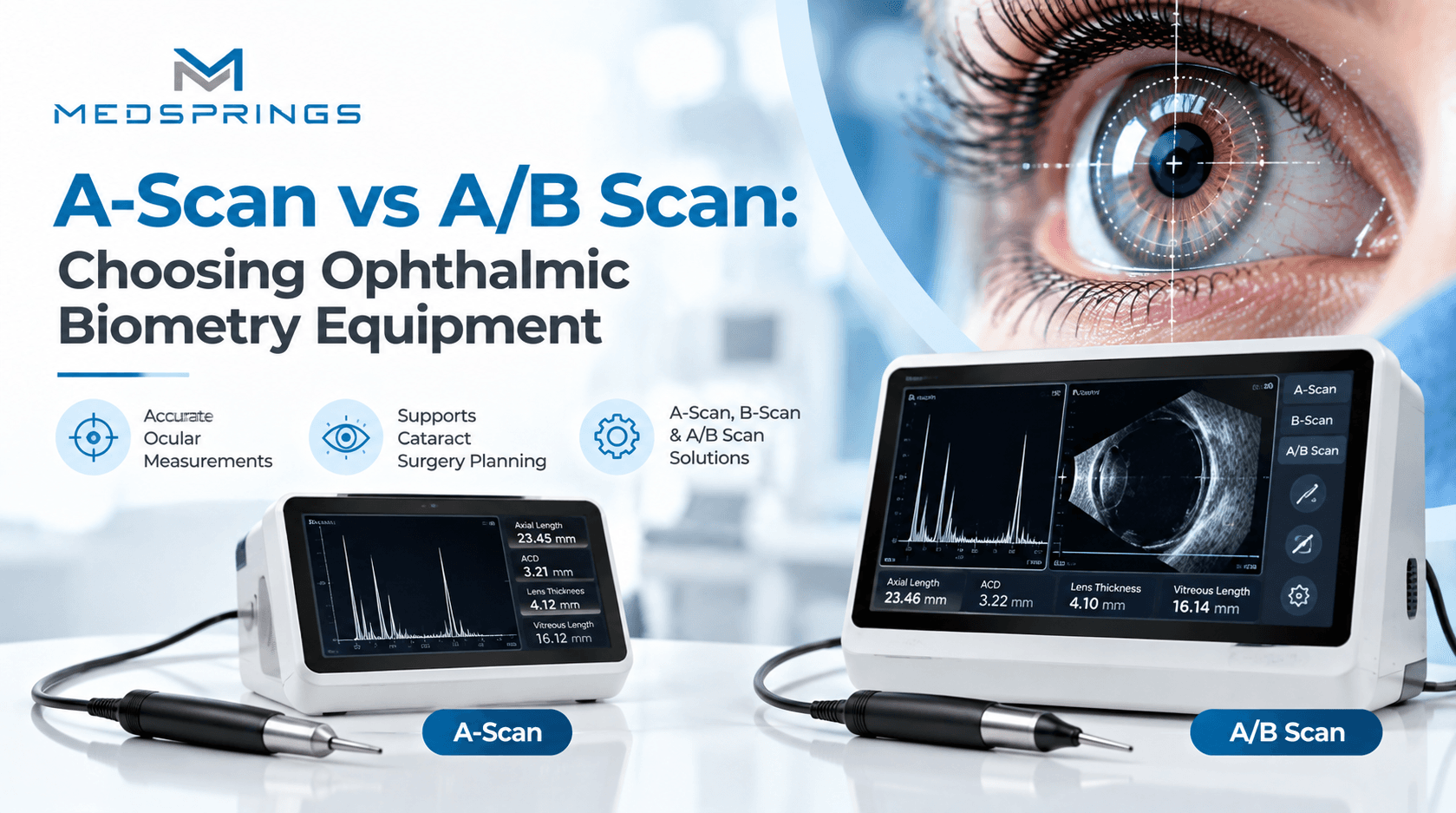
A-Scan vs A/B Scan: Choosing Ophthalmic Biometry Equipment
A-Scan and A/B Scan systems are both used in ophthalmic ultrasound, but they serve different clinical requirements. An A-Scan biometer primarily provides ocular measurements used for biometry and intraocular lens (IOL) power calculation, while an A/B Scan system combines biometric measurement with two-dimensional B-scan imaging for posterior-segment evaluation.
For eye hospitals, ophthalmology clinics, cataract centres, diagnostic facilities, distributors, and healthcare procurement teams, understanding the difference can make it easier to select the right ophthalmic biometry equipment for their clinical workflow.
Medsprings provides both A-Scan Biometer and A/B Scan Ophthalmic Ultrasound Workstation solutions as part of its broader ophthalmic equipment portfolio.
What Is an A-Scan?
An A-Scan, or amplitude scan, is a one-dimensional ultrasound technique used to measure distances between anatomical interfaces within the eye.
In ophthalmic biometry, A-Scan is commonly used to measure axial length, an important measurement for IOL power calculation before cataract surgery. Depending on the system, additional measurements such as anterior chamber depth, lens thickness, and vitreous chamber depth can also be obtained.
Modern A-Scan biometers can also incorporate IOL calculation formulas, allowing measurements to be used directly as part of the preoperative planning workflow.
What Does an A-Scan Measure?
Depending on the system and examination mode, measurements can include:
- Axial length
- Anterior chamber depth
- Lens thickness
- Vitreous chamber depth
- Other ocular biometric parameters
The Medsprings A-Scan Biometer provides ACD, lens thickness, vitreous chamber depth, and axial length measurements, with contact and immersion acquisition modes.
What Is a B-Scan?
A B-Scan, or brightness scan, produces a two-dimensional ultrasound image of ocular structures rather than simply displaying echo amplitudes along a single measurement line.
B-scan ultrasonography can be particularly useful when direct visualization of the posterior segment is difficult. Applications can include evaluation of the retina, vitreous, choroid, sclera, orbital structures, masses, and retinal detachment.
This makes B-scan imaging complementary to conventional A-scan biometry.
What Is an A/B Scan System?
An A/B Scan system combines the two ultrasound modes in one ophthalmic diagnostic platform.
Instead of purchasing separate equipment for biometric measurement and B-scan imaging, an integrated A/B Scan workstation can provide:
- A-Scan biometry
- Axial length measurement
- IOL power calculation
- B-Scan posterior-segment imaging
- Real-time ultrasound visualization
- Additional diagnostic assessment
Medsprings' A/B Scan Ophthalmic Ultrasound Workstation combines A-Scan biometry and B-Scan diagnostic imaging in one system. Its listed applications include IOL power calculation and evaluation of conditions such as retinal detachment, vitreous hemorrhage, and posterior ocular masses.
A-Scan vs A/B Scan: What's the Difference?
The simplest distinction is:
A-Scan = measurement and biometry
A/B Scan = measurement + two-dimensional ultrasound imaging
| Feature | A-Scan Biometer | A/B Scan System |
|---|---|---|
| Axial length measurement | Yes | Yes |
| Ocular biometry | Yes | Yes |
| IOL power calculation | Yes | Yes |
| A-Scan waveform | Yes | Yes |
| B-Scan imaging | No | Yes |
| Posterior-segment visualization | Limited to A-scan information | Yes |
| Retinal assessment | Not the primary function | Yes |
| Vitreous evaluation | Limited | Yes |
| Ocular mass assessment | Not the primary function | Yes |
| Integrated diagnostic ultrasound | No | Yes |
| Best suited for | Biometry-focused workflows | Combined biometry + ultrasound workflows |
The exact capabilities depend on the specific system, configuration, probes, and software.
When Should a Clinic Choose an A-Scan Biometer?
An A-Scan biometer can be an appropriate choice when the primary requirement is ocular biometry and IOL power calculation.
For example, a cataract-focused ophthalmology clinic may primarily need accurate measurements for surgical planning rather than comprehensive posterior-segment ultrasound imaging.
The Medsprings A-Scan Biometer includes:
- 10 MHz focused acoustic transducer
- Contact and immersion measurement modes
- Axial length measurement
- Anterior chamber depth measurement
- Lens thickness measurement
- Vitreous chamber depth measurement
- Multiple IOL calculation formulas
- Automatic and manual acquisition modes
- Normal, aphakic, pseudophakic, and dense cataract settings
This makes a dedicated A-Scan solution particularly relevant when ophthalmic biometry is the primary clinical requirement.
When Should a Clinic Choose an A/B Scan System?
An A/B Scan ophthalmic ultrasound system may be more appropriate when a facility requires both biometric measurements and posterior-segment ultrasound imaging.
This can be particularly useful for:
- Comprehensive eye hospitals
- Ophthalmology diagnostic centres
- Surgical centres
- Vitreoretinal practices
- Facilities handling complex diagnostic cases
- Hospitals seeking a combined ultrasound platform
The Medsprings A/B Scan workstation combines A-Scan and B-Scan functionality and includes real-time B-scan visualization, automatic spike acquisition, and multiple IOL calculation formulas.
A-Scan for Cataract Surgery Planning
One of the most important applications of A-Scan biometry is preoperative assessment for cataract surgery.
Axial length is an important input in IOL power calculation. A-Scan ultrasound measures the distance between ocular interfaces and can provide axial-length data used alongside other biometric measurements and IOL calculation formulas.
Modern biometers may also provide measurements such as anterior chamber depth and lens thickness, which can be incorporated into contemporary IOL calculation workflows.
This makes A-Scan biometry equipment particularly relevant to cataract surgery centres.
Contact vs Immersion A-Scan
A-Scan systems can use different measurement approaches, including contact/applanation and immersion techniques.
With contact biometry, the probe contacts the cornea. With immersion biometry, a fluid-filled shell is used to create a coupling environment between the probe and eye.
The choice of technique depends on the equipment, clinical workflow, patient characteristics, and operator preference.
Medsprings' A-Scan Biometer supports both direct applanation/contact and non-contact immersion acquisition modes.
Why B-Scan Imaging Matters
While A-Scan is primarily concerned with measurements, B-Scan provides a visual representation of ocular structures.
This can become particularly valuable when the posterior segment cannot be adequately examined through conventional optical methods.
B-scan ultrasound can assist in evaluating:
- Retinal detachment
- Vitreous hemorrhage
- Vitreous abnormalities
- Choroidal abnormalities
- Ocular masses
- Foreign bodies
- Orbital lesions
- Posterior-segment structures
Therefore, a clinic that frequently encounters complex posterior-segment cases may benefit from having B-scan capability alongside its biometric workflow.
A-Scan vs A/B Scan: Which One Is Right for Your Clinic?
The answer depends largely on the clinical workflow rather than which technology is inherently better.
Choose an A-Scan when:
- Your primary requirement is ocular biometry
- You perform a significant volume of cataract evaluations
- IOL power calculation is the main requirement
- You do not regularly require B-scan imaging
- You want a focused biometry solution
- Space and equipment requirements need to remain streamlined
Choose an A/B Scan when:
- You require both biometry and diagnostic ultrasound
- Your facility evaluates posterior-segment conditions
- You want B-scan imaging alongside A-scan measurement
- You manage complex ophthalmic cases
- You operate a comprehensive eye hospital or diagnostic centre
- You prefer an integrated workstation rather than separate systems
For larger facilities, the additional B-scan capability can provide broader diagnostic utility.
What to Consider Before Buying Ophthalmic Biometry Equipment
Choosing an ophthalmic biometer involves more than comparing whether a system has A-Scan or A/B Scan functionality.
1. Measurement Capability
Check which biometric parameters the equipment provides.
Depending on the clinical requirement, this may include:
- Axial length
- Anterior chamber depth
- Lens thickness
- Vitreous chamber depth
2. IOL Calculation Formulas
IOL calculation functionality is an important consideration for cataract surgery centres.
The Medsprings A-Scan Biometer supports formulas including:
- SRK/T
- Hoffer-Q
- Holladay 1
- Haigis
- Binkhorst-II
- SRK-II
The A/B Scan workstation also provides multiple IOL calculation formulas, including SRK-II, SRK-T, Binkhorst, Holladay, Hoffer-Q, and Haigis.
3. Contact and Immersion Modes
If the facility uses different biometry techniques, check whether the system supports the required acquisition method.
4. Patient and Eye-Type Settings
Consider whether the equipment supports different clinical situations, including:
- Normal eyes
- Aphakic eyes
- Pseudophakic eyes
- Dense cataracts
Both Medsprings systems list support for these eye-status settings.
5. B-Scan Capability
If posterior-segment imaging is important to your practice, an integrated A/B Scan system can provide functionality beyond dedicated A-Scan biometry.
6. Workflow and Usability
Consider:
- Display quality
- Probe handling
- Automatic acquisition
- Manual acquisition
- Data storage
- IOL calculation workflow
- Ease of operation
- Integration into the clinical environment
A system that fits naturally into the existing workflow can be more useful than one selected solely on technical specifications.
A-Scan and A/B Scan for Hospitals and Diagnostic Centres
Healthcare facilities should consider their patient profile and clinical services before selecting ophthalmic ultrasound equipment.
A dedicated cataract clinic may prioritise A-Scan biometry, while a comprehensive ophthalmology hospital may benefit from the broader capabilities of an A/B Scan workstation.
For procurement teams, this means assessing:
- Patient volume
- Cataract surgery workload
- Diagnostic services
- Vitreoretinal services
- Posterior-segment assessment requirements
- Existing equipment
- Available clinical space
- Budget and procurement requirements
- Technical and product support
This approach helps align equipment selection with actual clinical requirements.
A-Scan and A/B Scan Equipment for Distributors
For medical distributors and importers, understanding the difference between these two categories can also help when recommending equipment to different healthcare customers.
A smaller ophthalmology clinic may require a dedicated A-Scan biometer, while a larger eye hospital may benefit from an integrated A/B Scan ophthalmic ultrasound workstation.
Having access to both types of systems allows distributors to address different customer requirements without treating every facility as having the same equipment needs.
Medsprings supports healthcare procurement and distribution requirements through a broader Ophthalmic Equipment portfolio covering biometry, ocular examination, tonometry, lens measurement, vision and refraction, and other ophthalmic equipment categories.
Medsprings Ophthalmic Biometry Equipment
Medsprings provides both dedicated and integrated ophthalmic ultrasound solutions.
A-Scan Biometer
The Medsprings A-Scan Biometer is designed for ophthalmic clinics and surgical environments requiring ocular biometry and IOL power calculation.
It supports contact and immersion acquisition and provides measurements including axial length, anterior chamber depth, lens thickness, and vitreous chamber depth.
A/B Scan Ophthalmic Ultrasound Workstation
The Medsprings A/B Scan Ophthalmic Ultrasound Workstation combines A-Scan biometry with B-Scan diagnostic imaging.
The system is designed for comprehensive eye-care centres, operating rooms, and diagnostic clinics requiring both biometric measurement and posterior-segment ultrasound capabilities.
A Broader Ophthalmic Equipment Portfolio
Biometry is one part of the wider Medsprings ophthalmic equipment portfolio.
Healthcare organisations can also explore:
- Ophthalmic Equipment
- Ocular Examination Equipment
- Lens Measurement Equipment
- Ophthalmic Viscosurgical Devices
- Ophthalmic Knives
- Surgical Instruments & Consumables
This broader portfolio allows Medsprings to support hospitals, eye clinics, distributors, importers, and healthcare procurement professionals as an ophthalmic supply partner and solution provider.
Frequently Asked Questions
What is the difference between A-Scan and B-Scan?
A-Scan provides a one-dimensional ultrasound measurement based on echo amplitudes and is widely used for ocular biometry, particularly axial-length measurement. B-Scan provides a two-dimensional ultrasound image for structural evaluation of the eye and posterior segment.
What is an A/B Scan ophthalmic ultrasound system?
An A/B Scan system combines A-Scan biometry and B-Scan diagnostic imaging in one platform. It can therefore support both biometric measurements and posterior-segment ultrasound evaluation.
Is A-Scan used for IOL power calculation?
Yes. A-Scan provides ocular biometric measurements, particularly axial length, that are used as part of IOL power calculation before cataract surgery.
When should a clinic choose an A/B Scan?
An A/B Scan can be useful for clinics and hospitals that require both ocular biometry and B-scan imaging, particularly facilities managing a broader range of diagnostic and posterior-segment cases.
Can A-Scan measure axial length?
Yes. Axial length is one of the primary measurements obtained through ophthalmic A-Scan biometry.
Which is better, A-Scan or A/B Scan?
Neither is universally better. A dedicated A-Scan can be appropriate when the main requirement is biometry and IOL calculation, while an A/B Scan may be more suitable when a facility also needs B-scan diagnostic imaging.
Choosing the Right Ophthalmic Biometry Equipment
The choice between A-Scan and A/B Scan should ultimately be based on the clinical services, patient requirements, diagnostic workflow, and future needs of the facility.
For cataract-focused practices primarily requiring ocular biometry and IOL calculation, a dedicated A-Scan Biometer may provide the appropriate functionality.
For comprehensive eye hospitals and diagnostic centres requiring both biometry and posterior-segment ultrasound imaging, an integrated A/B Scan workstation can provide broader functionality in a single system.
Explore the A-Scan Biometer, A/B Scan Ophthalmic Ultrasound Workstation, or the complete Ophthalmic Equipment portfolio from Medsprings.