


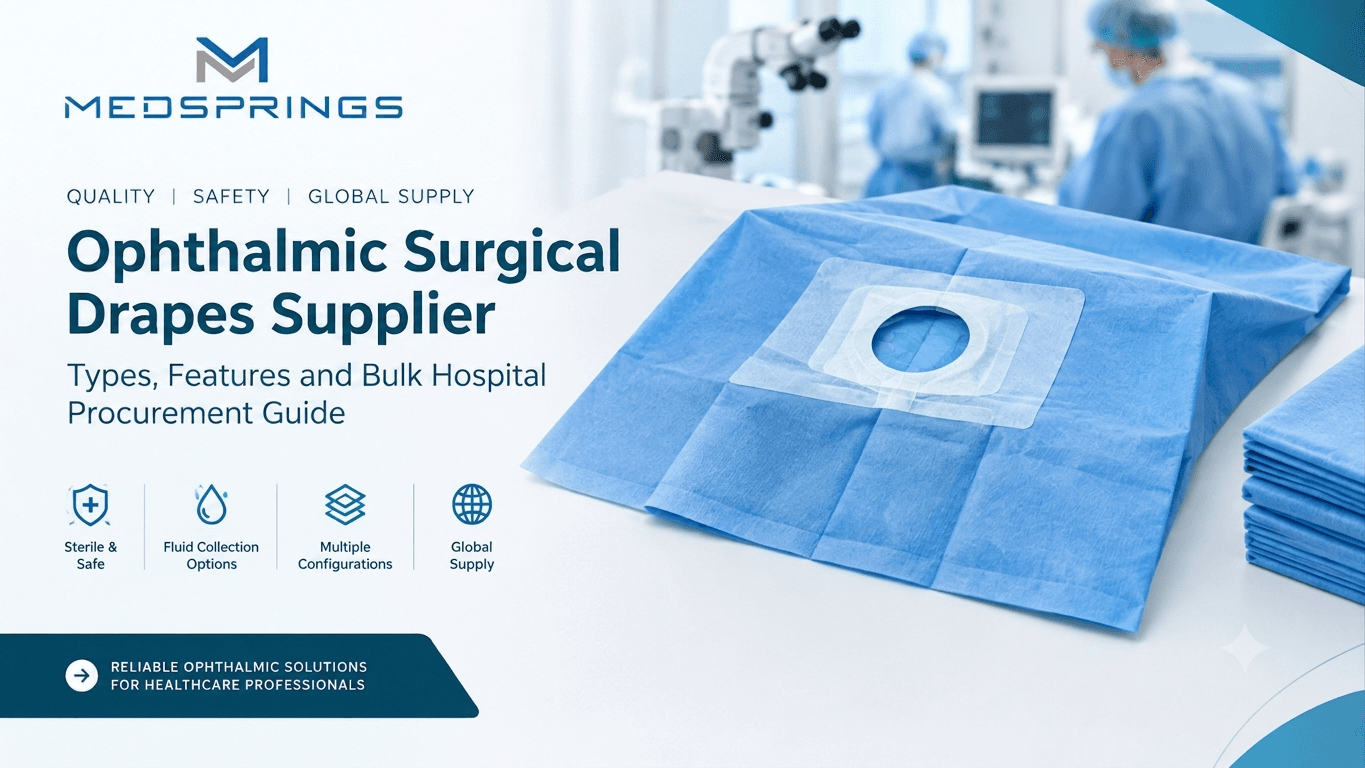
Ophthalmic Surgical Drapes Supplier: Types, Features and Bulk Hospital Procurement Guide
Choosing the right ophthalmic surgical drapes is an important part of operating-room preparation and surgical consumables procurement. Hospitals, eye clinics, cataract centres and medical distributors need drapes that match their procedural requirements, provide appropriate fluid management and meet the specifications of their infection prevention and control protocols.
For procurement teams, selecting an ophthalmic surgical drapes supplier involves more than comparing prices. Material construction, sterile packaging, aperture design, collection bag configuration, dimensions, documentation and supply consistency all need to be evaluated.
Whether you are sourcing sterile eye drapes for a hospital, purchasing disposable ophthalmic drapes in bulk or expanding a medical distribution portfolio, this guide explains the key product features and purchasing considerations.
Medsprings offers ophthalmic surgical drapes in multiple configurations, including pre-cut aperture options, solid sheets and versions with or without integrated fluid collection bags.
Looking for ophthalmic surgical drapes for your hospital or distribution business? Explore Medsprings Drapes or request a product quotation.
1. What Are Ophthalmic Surgical Drapes?
Ophthalmic surgical drapes are sterile coverings used during eye procedures to establish a barrier around the operative area and help maintain an appropriately prepared surgical environment.
They are designed to cover the patient and surrounding areas while providing access to the surgical site. Depending on their configuration, they may include an aperture, an adhesive border, absorbent sections or an integrated fluid collection pouch.
In ophthalmic procedures, irrigation solutions and other fluids may collect around the operative area. A suitably configured drape can help manage this fluid and support an organised surgical workspace.
Hospitals generally evaluate surgical drapes based on:
-
Material construction and barrier characteristics
-
Sterility and packaging integrity
-
Aperture size and configuration
-
Adhesive positioning and skin compatibility information
-
Fluid absorption and collection arrangements
-
Dimensions and coverage requirements
-
Product labelling and technical documentation
The appropriate configuration should always be selected according to the procedure, manufacturer's instructions and the healthcare facility's infection prevention protocol.
2. Types of Ophthalmic Surgical Drapes Available
Ophthalmic surgical drapes are available in different configurations to meet the requirements of eye surgery centres, hospitals and operating rooms.
A. Ophthalmic Drapes With Fluid Collection Bags
These drapes feature an integrated pouch designed to collect fluid generated during procedures.
Fluid collection bags can help manage irrigation runoff and reduce fluid accumulation around the operative area.
When evaluating these drapes, procurement teams should consider:
-
Collection pouch dimensions
-
Pouch positioning
-
Drainage port or filter configuration
-
Fluid capacity and handling instructions
-
Compatibility with the intended procedure
Medsprings offers drape configurations with integrated fluid collection bag options.
B. Ophthalmic Drapes Without Fluid Collection Bags
Some procedures and operating-room requirements may call for a simpler drape configuration without an integrated collection pouch.
These options can be considered when the clinical team has a separate fluid management arrangement or does not require a collection bag.
Important purchasing considerations include:
-
Overall dimensions
-
Coverage area
-
Material construction
-
Aperture requirements
-
Packaging and sterility
C. Pre-Cut Aperture Ophthalmic Drapes
Pre-cut aperture drapes feature an opening designed to provide access to the operative area while covering the surrounding region.
The aperture may be available in different shapes, depending on the product configuration.
Common aperture configurations include:
-
Circular apertures
-
Oval apertures
-
Rectangular apertures
The dimensions and positioning of the opening should be checked against the intended surgical application.
D. Solid-Sheet Ophthalmic Drapes
Solid-sheet drapes are supplied without a pre-cut aperture.
They provide a continuous covering surface and may be selected when the clinical team requires a particular positioning or access arrangement.
Before ordering, buyers should verify the dimensions, intended use and application instructions of the selected drape.
Explore the available configurations: Medsprings Ophthalmic Drapes.
3. Materials Used in Disposable Ophthalmic Drapes
Material construction is an important consideration when sourcing disposable surgical drapes.
Different material combinations influence liquid resistance, absorbency, strength, flexibility and drapeability.
SMS Non-Woven Material
SMS stands for Spunbond-Meltblown-Spunbond. It is a multilayer non-woven material structure used in various medical disposable products.
Depending on its construction and validated performance, SMS material can provide characteristics such as:
-
Lightweight construction
-
Softness and flexibility
-
Resistance to tearing
-
Fluid barrier performance
-
Suitability for disposable medical applications
Poly-Laminated Absorbent Fabric
Poly-laminated materials combine non-woven fabric with a polymer film or other functional layers.
Depending on the construction, they can provide a combination of absorbency and liquid resistance.
For surgical drapes, the material should be evaluated according to the performance required in the intended procedure.
Why Material Specifications Matter
When comparing ophthalmic surgical drapes from different suppliers, buyers should not rely on material names alone.
Ask for relevant technical details, including:
-
Material composition
-
Fabric weight, where specified
-
Liquid penetration resistance
-
Tensile and tear strength
-
Absorbency characteristics
-
Linting performance
-
Applicable test reports and product documentation
A supplier should be able to clarify the actual specifications of the product being quoted.
4. Important Features to Consider When Buying Ophthalmic Drapes
For hospitals and medical distributors, the following features can help evaluate different ophthalmic drape configurations.
Sterile Single-Use Packaging
Sterile packaging is an important requirement when purchasing drapes intended for sterile surgical applications.
Buyers should verify:
-
Sterile or non-sterile product status
-
Sterilisation method
-
Packaging integrity
-
Sterilisation and batch traceability information
-
Shelf life and storage instructions
-
Manufacturer's instructions for use
Do not assume that all disposable drapes are supplied sterile. Confirm the status of each product before ordering.
Adhesive Border
An adhesive border can help position and secure a drape around the intended application area.
Procurement teams should review the adhesive design, dimensions, application instructions and available skin compatibility information.
An adhesive positioning border should not automatically be confused with an antimicrobial adhesive incise film. These are different product features.
Fluid Collection Bag
An integrated fluid collection bag can be useful for procedures involving irrigation and fluid runoff.
Check whether the pouch includes a filter, drainage port or other fluid management features.
Absorbency and Impermeability
A drape may incorporate absorbent sections alongside liquid-resistant layers.
These characteristics should be assessed through relevant product specifications and test documentation rather than assumed from the material description.
Size and Coverage
Choosing the correct dimensions is essential for adequate coverage and compatibility with the intended procedure.
Common purchasing questions include:
-
What is the overall drape size?
-
What are the aperture dimensions?
-
Is a collection pouch included?
-
Is the configuration suitable for the intended operating-room setup?
-
Are alternative sizes available?
5. Medsprings Ophthalmic Drapes: Product Specifications
Medsprings offers surgical drapes in different configurations for healthcare procurement requirements.
The listed product specifications include:
| Specification | Available options |
|---|---|
| Material construction | Non-woven SMS / poly-laminated absorbency fabric |
| Aperture configuration | Pre-cut aperture / solid sheet |
| Aperture shapes | Circular, oval and rectangular |
| Collection bag | With or without collection bag |
| Collection bag material | Polyethylene film |
| Collection bag features | Filter / drainage port options |
| Sterilisation methods listed | Ethylene Oxide (ETO) / Gamma |
| Available sizes | 50 × 40 cm |
| Additional sizes | 60 × 60 cm, 90 × 75 cm, 100 × 120 cm, 100 × 70 cm |
Configurations, sizes and features are subject to product availability. Confirm the exact specification, sterile status, packaging and sterilisation documentation for the selected configuration before placing an order.
View the product: Medsprings Drapes – Technical Specifications and Enquiry
6. How Hospitals Should Evaluate an Ophthalmic Surgical Drapes Supplier
Selecting a reliable ophthalmic drapes supplier is an important decision for hospital procurement departments and medical distributors.
Rather than evaluating suppliers exclusively on unit price, buyers should assess the following areas.
Product Range and Configuration Options
A supplier should clearly communicate the available product configurations.
For example, hospitals may need different combinations of:
-
Pre-cut apertures
-
Solid-sheet drapes
-
Integrated fluid collection bags
-
Different drape dimensions
-
Different material constructions
A clear product catalogue makes it easier to match purchasing requirements with available products.
Technical Documentation
Request the technical documents relevant to the specific product.
These may include:
-
Product specification sheets
-
Instructions for use
-
Sterilisation information
-
Packaging details
-
Batch and traceability information
-
Applicable test reports
-
Regulatory and conformity documentation, where required
Documentation requirements differ between destination markets. Buyers should verify the documents needed for their local regulatory and import requirements.
Quality and Performance Information
Evaluate the supplier's ability to provide documented information about material characteristics, barrier performance, packaging integrity and sterility.
Where applicable, ask about recognised standards and the test methods used to support product claims.
Bulk Supply Capability
For hospitals and distributors, consistent availability is an important purchasing consideration.
Discuss:
-
Minimum order quantities
-
Carton and packaging quantities
-
Production or dispatch lead times
-
Repeat-order availability
-
Export packaging
-
Shipping destinations
-
Quotation validity
Communication and Export Support
International buyers should also assess the supplier's ability to communicate clearly and support export enquiries.
A well-structured quotation should identify the product configuration, quantity, unit price, packaging, delivery terms and relevant documentation.
7. Standards and Compliance: What Buyers Should Verify
Surgical drapes are medical products, and applicable standards and regulatory requirements depend on their intended use and destination market.
Two important references buyers may encounter are:
EN 13795-1:2025
This European standard addresses requirements and test methods for surgical drapes and gowns, including characteristics such as barrier performance and product performance. Buyers sourcing for European markets should confirm the applicable version and the exact scope of any supplier conformity claim.
Reference: EN 13795-1:2025 – Italian Standards Body
ANSI/AAMI PB70
This standard provides a framework for classifying liquid barrier performance of protective apparel and drapes used in healthcare facilities.
Buyers should request supporting documentation for any claimed barrier performance level rather than relying on a general product description.
Reference: CDC – Standards and Specifications for Healthcare Protective Clothing
It is also important to understand that no single standard or certification automatically establishes suitability for every ophthalmic procedure or every destination market.
Important clinical distinction: The World Health Organization recommends sterile disposable non-woven or sterile reusable woven drapes and gowns as options for surgical procedures, while recommending against the use of plastic adhesive incise drapes for the purpose of preventing surgical site infections. Procurement teams should therefore distinguish between drape positioning features and adhesive incise films, and follow current clinical guidance.
Reference: WHO Global Guidelines for the Prevention of Surgical Site Infection
Medsprings buyers should request the applicable product documentation and verify regulatory requirements for their destination country before purchase.
8. Bulk Procurement Checklist for Hospitals and Medical Distributors
Before requesting a quotation, prepare the following information to help suppliers provide an accurate offer.
| Procurement requirement | Details to confirm |
|---|---|
| Product type | Ophthalmic surgical drape |
| Aperture | Pre-cut or solid sheet |
| Aperture shape | Circular, oval or rectangular |
| Collection bag | Required / not required |
| Material | SMS or poly-laminated construction |
| Dimensions | Required drape size |
| Sterile status | Sterile / non-sterile |
| Sterilisation | Required method and documentation |
| Quantity | Units or cartons required |
| Destination | Country and delivery location |
| Documentation | Product specifications and applicable conformity documents |
Providing these details can reduce clarification delays and help procurement teams compare quotations more accurately.
9. Why Source Ophthalmic Surgical Drapes from Medsprings?
Medsprings supports hospitals, ophthalmology clinics, medical distributors and importers seeking ophthalmic surgical products and consumables.
Its drapes portfolio includes multiple configurations designed to address different surgical coverage and fluid management requirements.
Buyers can discuss:
-
Drape configurations with or without fluid collection bags
-
Pre-cut aperture and solid-sheet options
-
Available product dimensions
-
Material and technical specifications
-
Bulk purchasing requirements
-
International sourcing and export enquiries
In addition to surgical drapes, Medsprings provides access to a broader portfolio of ophthalmic products, supporting procurement teams looking to consolidate sourcing across multiple product categories.
Explore the wider Disposable OT Consumables range or browse the complete Medsprings product catalogue.
10. Request a Bulk Quotation for Ophthalmic Surgical Drapes
Are you sourcing sterile ophthalmic surgical drapes for a hospital, eye clinic, surgical centre or medical distribution business?
Medsprings welcomes product enquiries from domestic and international buyers.
To receive a relevant quotation, share:
-
Required drape configuration
-
Preferred dimensions
-
Aperture requirements
-
Collection bag requirements
-
Required quantity
-
Destination country
-
Any technical documentation or regulatory requirements
Our team can review your requirements and assist with product and quotation information.
For wider procurement requirements, explore Medsprings Ophthalmic Products.
Frequently Asked Questions
1. What are ophthalmic surgical drapes used for?
Ophthalmic surgical drapes are used to cover the patient and surrounding areas during eye procedures, helping establish an appropriately prepared surgical field and manage fluid around the operative site.
2. What types of ophthalmic surgical drapes are available?
Common configurations include drapes with or without fluid collection bags, pre-cut aperture drapes and solid-sheet drapes. The appropriate configuration depends on the intended procedure and operating-room requirements.
3. What is the purpose of a fluid collection bag in an eye drape?
An integrated collection bag helps collect irrigation fluid and other runoff generated during a procedure, supporting fluid management around the surgical area.
4. What materials are used in disposable ophthalmic drapes?
Common constructions include SMS non-woven materials and poly-laminated absorbent fabrics. The precise composition and performance should be confirmed using the product's technical specifications.
5. What sizes of ophthalmic drapes does Medsprings offer?
The Medsprings product listing includes 50 × 40 cm, 60 × 60 cm, 90 × 75 cm, 100 × 120 cm and 100 × 70 cm options. Confirm current availability and configuration with the sales team.
6. Are Medsprings surgical drapes available in bulk quantities?
Medsprings accepts product enquiries from hospitals, clinics, distributors and importers. Buyers can submit their required quantities and destination details to discuss bulk supply and quotation options.
7. What documents should buyers request when purchasing sterile surgical drapes?
Depending on the destination market and product, buyers may request technical specifications, instructions for use, sterilisation information, packaging details, batch traceability and applicable regulatory or conformity documentation.
8. How can I request a quotation for ophthalmic surgical drapes?
Visit the Medsprings Drapes product page and submit an enquiry with your required configuration, dimensions, quantity and destination country.
Source and clinical reference links
This article is intended for product sourcing and procurement information. Product selection and clinical use should follow the manufacturer's instructions and the healthcare facility's applicable protocols.